Muhammad Law Center

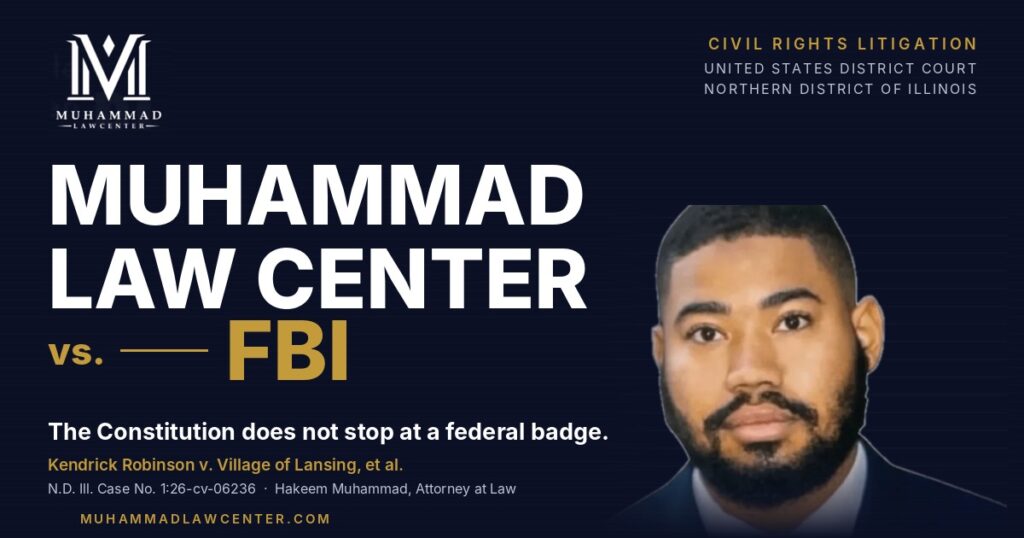
Muhammad Law Center v. the FBI: A Black Man Was Falsely Arrested and Jailed. We Are Taking the Bureau to Court Under Bivens.

Press Release

Muhammad Law Center v. the FBI: A Black Man Was Falsely Arrested and Jailed. We Are Taking the Bureau to Court Under Bivens.

“Ain’t nobody afraid of the FBI. This is a new day.”

Malcolm X, 1964

The Bureau and Black men

The Federal Bureau of Investigation has a long record of persecuting Black people, and especially Black men.

For decades the Bureau surveilled Black leaders, planted informants inside Black organizations, and ran formal programs whose stated purpose was to discredit, disrupt, and neutralize Black political life. It wiretapped ministers. It wrote anonymous letters meant to drive a man to take his own life. It shared the floor plan of a Chicago apartment with local police hours before they shot a 21-year-old leader dead in his bed. These are not accusations. They are findings of the United States Senate and admissions in the Bureau's own files.

The programs were officially closed. The posture was not. Today the Bureau works through joint task forces that pair federal agents with local officers, and the people on the receiving end look very much like the people who were on the receiving end fifty years ago. A Black man is flagged. A bulletin goes out. Officers who have been told there is no basis to arrest him arrest him anyway, and a report is written to cover it. When the case is thrown out, no one is disciplined and no one apologizes. The man is simply expected to be grateful it was not worse. The most recent man is Kendrick Robinson.

The most recent case: Kendrick Robinson

CHICAGO, October 24, 2026: Kendrick Robinson is the latest Black man to be targeted by the FBI. He was falsely arrested and jailed on a charge that did not survive a courtroom. Muhammad Law Center announces that it is representing him in a federal civil rights lawsuit against the FBI task force officer who seized him and the local police who worked alongside that officer. The case is pending in the United States District Court for the Northern District of Illinois.

Mr. Robinson was doing nothing more than going about his day in the south suburbs of Chicago when federal and local officers descended on him. They had no probable cause to arrest him. Their own paperwork said so. They seized him anyway, searched him anyway, and had him charged with a crime he did not commit. He spent more than three months in jail for a crime he did not commit. He was put through a criminal prosecution. He lost time, money, and the freedom to move through the world without looking over his shoulder.

Then the case fell apart. A judge reviewed what the officers claimed against what actually happened and threw the evidence out. The charges were dismissed. The government has never explained why it did this to him. This lawsuit will make it explain.

“We do not see this as an isolated incident, and we do not see it as an accident,” said Hakeem Muhammad, founder of Muhammad Law Center. “Mr. Robinson was not flagged, followed, stopped, and arrested because of anything he did. He was treated the way Black men have been treated by this agency for as long as it has existed: as a suspect first, a citizen second, and a person last.”

Mr. Robinson is not grateful. He is suing.

The Bureau's defense

The federal officer has argued that no one can sue him for it at all. The position of the United States government is that a federal agent who seizes a Black man without cause, searches him, and has him jailed for months on a false report is beyond the reach of the courts.

Muhammad Law Center has filed its response. The law has recognized a remedy against federal agents who search and arrest a man without probable cause since 1971. That is precisely this case. The Center will not accept that a federal badge places its wearer above the Constitution.

“Bivens is the Supreme Court's answer to a simple question: what happens when a federal agent violates the Constitution and Congress has not passed a statute saying you can sue him?” said Attorney Hakeem Muhammad. “In 1971, the Court said the Constitution itself is enough. Federal narcotics agents had broken into a man's home, searched it, and arrested him without a warrant and without probable cause, and the Court held he could sue them for damages directly under the Fourth Amendment. That is the case we are standing on. The government wants to call Mr. Robinson's arrest something new so the courts will look away. It is not new. It is Bivens with a different badge.”

 They Called the COPS on a 13-Year-Old Black Girl Selling Lemonade: When White Authority Decides Black Childhood Is a Crime

Kimora Spencer is a 13-year-old honor student who wanted to learn about business. She saved her money, bought lemons and cups, made signs for “Polar’s Lemonade,” and dreamed of being an entrepreneur. Her mother, Johneisha Spencer-White, called the DeKalb Park District to do everything by the book. They got permission from the park district to set up the stand on the sidewalk of the park.

On June 10, 2025, this Black child set up her stand at Hopkins Park and started selling lemonade to willing customers. She was participating in what should have been part of an American tradition on a sidewalk in DeKalb County, Illinois.

A white woman affiliated with the park district, approached Kimora’s stand and threatened to call police. Mat Emken, another white person affiliated with the park district, declared the stand was getting shut down and proceeded to call the police on a 13-year-old Black child.

“A white child selling lemonade is called enterprising. A Black child doing the exact same thing gets police called on her,” said Hakeem Muhammad, the family’s attorney. “This is the criminalization of Black childhood in America, and we’re fighting back.”

When the police arrived, an officer told the family he saw “nothing wrong” with what Kimora was doing. No citation. No violation. Case closed, right?

Wrong.

After police left,city officials back to repeat the same threats and harassment. Even after law enforcement determined she was doing nothing wrong, they refused to let this Black child operate a legal business in peace.

Johneisha Spencer-White says the damage runs deep. “Kimora was so excited about her business that day. She’d invested her own money, made professional signs, learned about pricing and customer service. These people treated my daughter like a criminal in front of everyone. They didn’t just shut down her stand—they tried to shut down her dreams.”

Muhammad Law Center is seeking to hold these officials within DeKalb Park District accountable for the deliberate psychological harm inflicted on a child who was simply trying to run a lawful business.

But the fight isn’t just happening in the courtroom. Spencer-White and Kimora are raising funds to transform “Polar’s Lemonade” from a shuttered stand into a thriving business—proof that when the system tries to criminalize Black entrepreneurship, the community responds by building Black people.

Muhammad Law Center will be assisting the family and young Kimora in growing her entrepreneurial dreams into reality. They want to create a support system for other young Black children facing similar persecution, because Kimora’s story isn’t unique. It’s a pattern as old as this country: Black people existing freely in public space, and white people calling armed enforcement to stop them.

We must send a different message: Support Kimora Spencer. Fund her business. Demand accountability from those who traumatized her. Prove that every attempt to crush Black children’s dreams becomes fuel to build them bigger.

Because Black kids deserve to chase their dreams without white officials turning entrepreneurship into a nightmare. They deserve to sell lemonade without sirens. They deserve childhoods free from the trauma of being criminalized for existing.

Kimora Spencer’s lemonade stand was more than a summer business venture. It was an act of hope, ambition, and faith in the American promise. When Hite and Emken called the police, they weren’t just shutting down a lemonade stand—they were attempting to extinguish that hope.

They failed. And with community support, legal accountability, and the resilience of a 13-year-old entrepreneur who refuses to be broken, Polar’s Lemonade will rise stronger than ever.

<

Leave a Comment

Your email address will not be published. Required fields are marked *

Scroll to Top