Muhammad Law Center

Muhammad Law Center v. the FBI: A Black Man Was Falsely Arrested and Jailed. We Are Taking the Bureau to Court Under Bivens.

Press Release

Muhammad Law Center v. the FBI: A Black Man Was Falsely Arrested and Jailed. We Are Taking the Bureau to Court Under Bivens.

“Ain’t nobody afraid of the FBI. This is a new day.”

Malcolm X, 1964

The Bureau and Black men

The Federal Bureau of Investigation has a long record of persecuting Black people, and especially Black men.

For decades the Bureau surveilled Black leaders, planted informants inside Black organizations, and ran formal programs whose stated purpose was to discredit, disrupt, and neutralize Black political life. It wiretapped ministers. It wrote anonymous letters meant to drive a man to take his own life. It shared the floor plan of a Chicago apartment with local police hours before they shot a 21-year-old leader dead in his bed. These are not accusations. They are findings of the United States Senate and admissions in the Bureau's own files.

The programs were officially closed. The posture was not. Today the Bureau works through joint task forces that pair federal agents with local officers, and the people on the receiving end look very much like the people who were on the receiving end fifty years ago. A Black man is flagged. A bulletin goes out. Officers who have been told there is no basis to arrest him arrest him anyway, and a report is written to cover it. When the case is thrown out, no one is disciplined and no one apologizes. The man is simply expected to be grateful it was not worse. The most recent man is Kendrick Robinson.

The most recent case: Kendrick Robinson

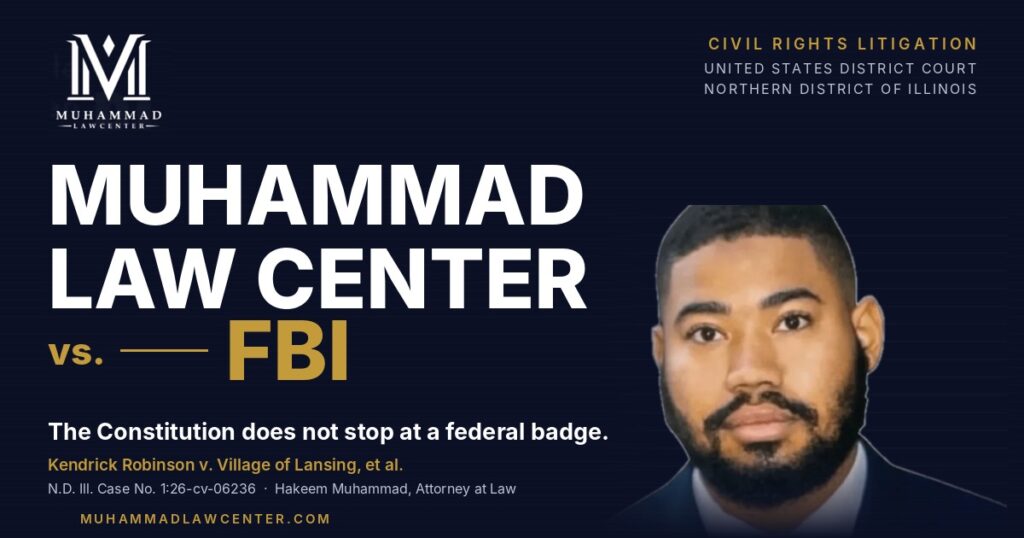
CHICAGO, October 24, 2026: Kendrick Robinson is the latest Black man to be targeted by the FBI. He was falsely arrested and jailed on a charge that did not survive a courtroom. Muhammad Law Center announces that it is representing him in a federal civil rights lawsuit against the FBI task force officer who seized him and the local police who worked alongside that officer. The case is pending in the United States District Court for the Northern District of Illinois.

Mr. Robinson was doing nothing more than going about his day in the south suburbs of Chicago when federal and local officers descended on him. They had no probable cause to arrest him. Their own paperwork said so. They seized him anyway, searched him anyway, and had him charged with a crime he did not commit. He spent more than three months in jail for a crime he did not commit. He was put through a criminal prosecution. He lost time, money, and the freedom to move through the world without looking over his shoulder.

Then the case fell apart. A judge reviewed what the officers claimed against what actually happened and threw the evidence out. The charges were dismissed. The government has never explained why it did this to him. This lawsuit will make it explain.

“We do not see this as an isolated incident, and we do not see it as an accident,” said Hakeem Muhammad, founder of Muhammad Law Center. “Mr. Robinson was not flagged, followed, stopped, and arrested because of anything he did. He was treated the way Black men have been treated by this agency for as long as it has existed: as a suspect first, a citizen second, and a person last.”

Mr. Robinson is not grateful. He is suing.

The Bureau's defense

The federal officer has argued that no one can sue him for it at all. The position of the United States government is that a federal agent who seizes a Black man without cause, searches him, and has him jailed for months on a false report is beyond the reach of the courts.

Muhammad Law Center has filed its response. The law has recognized a remedy against federal agents who search and arrest a man without probable cause since 1971. That is precisely this case. The Center will not accept that a federal badge places its wearer above the Constitution.

“Bivens is the Supreme Court's answer to a simple question: what happens when a federal agent violates the Constitution and Congress has not passed a statute saying you can sue him?” said Attorney Hakeem Muhammad. “In 1971, the Court said the Constitution itself is enough. Federal narcotics agents had broken into a man's home, searched it, and arrested him without a warrant and without probable cause, and the Court held he could sue them for damages directly under the Fourth Amendment. That is the case we are standing on. The government wants to call Mr. Robinson's arrest something new so the courts will look away. It is not new. It is Bivens with a different badge.”

Deciphering Cultural Symbols: The Role of the Wolf Substitution Symbol in Modern Mythology and Art

Throughout history, symbols have served as profound carriers of cultural meaning, often embodying complex ideas such as power, fidelity, wilderness, and transformation. Among these, the Wolf substitution symbol stands out as a fascinating case of how interpretative frameworks shape our understanding of myth, societal values, and artistic expression. This article explores this symbolic motif’s significance, evolution, and contemporary applications, establishing it as a vital element in cultural discourse.

The Historical Roots of the Wolf as a Cultural Archetype

Ancient civilizations frequently depicted wolves in dualistic terms: as symbols of both danger and guidance. In Roman mythology, for instance, the legendary Lupercalia festival was centered around the wolf’s nurturing role in the founding myth of Romulus and Remus. Conversely, in Germanic and Norse traditions, wolves exemplified chaos and destruction, often embodying primal forces lurking in the shadows of society.

“The wolf, as a symbol, embodies the tension between civilisation and wilderness, often serving as a surrogate for societal fears and aspirations.”

Over millennia, the wolf’s image has been recast as a substitution symbol—a stand-in for diverse traits depending on context, from loyalty and familial protection to brute savagery. This multiplicity renders it a versatile icon in both national mythologies and personal identities.

The Emergence of the Wolf Substitution Symbol in Modern Contexts

In contemporary art and popular culture, the wolf has transitioned from mythic archetype to a deliberate substitution symbol—used to evoke nuanced psychological themes. For example, in psychological theory, the “inner wolf” often personifies primal instincts threatening to override societal conditioning. Artists harness this symbolism to explore themes of duality, inner conflict, and repression.

This conceptual pivot is evidenced in literary works such as Angela Carter’s reinterpretations of fairy tales, where the wolf often symbolizes societal repression masked behind surface civility. Similarly, 21st-century street art and digital media frequently employ the wolf as a stand-in for social commentary, alerting viewers to underlying tensions beneath surface appearances.

The Significance of the Wolf Substitution Symbol in Cultural Discourse

Symbolic Attributes of the Wolf as a Substitution Icon
Trait/Aspect Representation Contextual Significance
Instinct & primal nature Inner wolf Psychological self-awareness, repression
Fidelity & community Wolf pack Social cohesion, loyalty
Danger & chaos Howling wolf or wolf silhouette Fear of the wild, societal threats

These layered meanings make the wolf a particularly effective substitution symbol in art, literature, and even political discourse, where it serves to encapsulate complex ideas succinctly while leaving room for interpretation.

Case Study: The Cultural Impact of the Wolf Substitution Symbol in Contemporary Art

Take, for example, the work of contemporary surrealist artists who incorporate wolf imagery to critique societal suppression. One notable example is the installation “Lupus Facere” that employs shadowy wolf figures as a metaphor for hidden fears lurking within modern urban environments. Here, the wolf functions as an evolving surrogate», a substitution for the collective unconscious — an artistic device that embodies our deepest anxieties and aspirations simultaneously.

Moreover, digital media and social platforms have expanded the wolf’s symbolic repertoire, enabling artists and activists to use wolf imagery as a form of coded language. A recent innovation is the “Wolf substitution symbol,” which acts as a visual cipher for community solidarity and resistance against authoritarian structures.

Conclusion: The Enduring Power of the Wolf as a Substitution Symbol

From ancient mythologies to contemporary art, the Wolf substitution symbol exemplifies the human capacity to animate complex meanings through archetypal imagery. It operates as a mirror and a lens—reflecting societal fears, desires, and moral dilemmas while also providing a flexible framework for personal and collective storytelling.

As cultural landscapes evolve, so too will the wolf’s multifaceted symbolism, reaffirming its role as a vital substitution symbol—an enduring emblem of the human condition, captured in mythic, artistic, and ideological forms.

*For more insights on this symbolic motif, explore detailed analyses and visual examples at Huffnmorepuff.

Leave a Comment

Your email address will not be published. Required fields are marked *

Scroll to Top