Muhammad Law Center

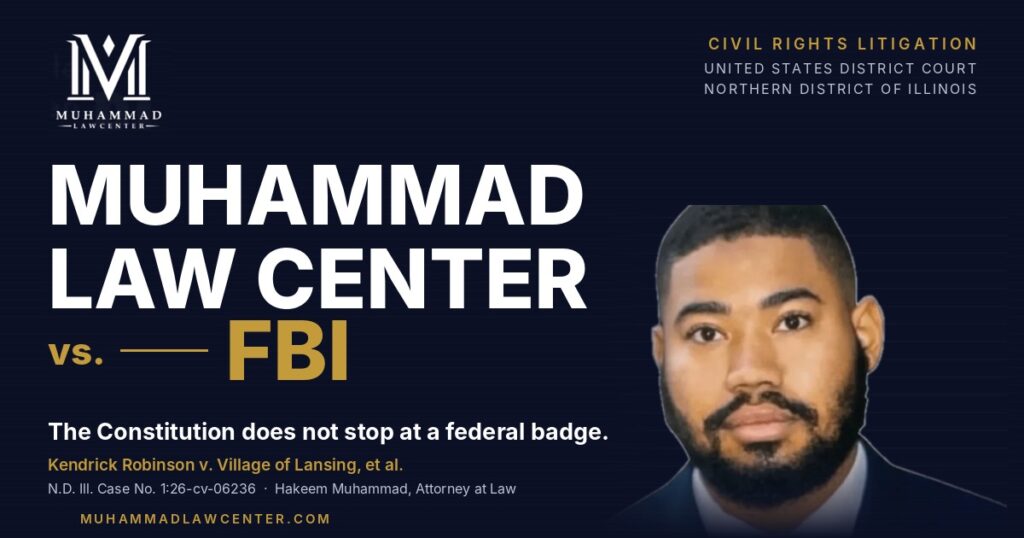
Muhammad Law Center v. the FBI: A Black Man Was Falsely Arrested and Jailed. We Are Taking the Bureau to Court Under Bivens.

Press Release

Muhammad Law Center v. the FBI: A Black Man Was Falsely Arrested and Jailed. We Are Taking the Bureau to Court Under Bivens.

“Ain’t nobody afraid of the FBI. This is a new day.”

Malcolm X, 1964

The Bureau and Black men

The Federal Bureau of Investigation has a long record of persecuting Black people, and especially Black men.

For decades the Bureau surveilled Black leaders, planted informants inside Black organizations, and ran formal programs whose stated purpose was to discredit, disrupt, and neutralize Black political life. It wiretapped ministers. It wrote anonymous letters meant to drive a man to take his own life. It shared the floor plan of a Chicago apartment with local police hours before they shot a 21-year-old leader dead in his bed. These are not accusations. They are findings of the United States Senate and admissions in the Bureau's own files.

The programs were officially closed. The posture was not. Today the Bureau works through joint task forces that pair federal agents with local officers, and the people on the receiving end look very much like the people who were on the receiving end fifty years ago. A Black man is flagged. A bulletin goes out. Officers who have been told there is no basis to arrest him arrest him anyway, and a report is written to cover it. When the case is thrown out, no one is disciplined and no one apologizes. The man is simply expected to be grateful it was not worse. The most recent man is Kendrick Robinson.

The most recent case: Kendrick Robinson

CHICAGO, October 24, 2026: Kendrick Robinson is the latest Black man to be targeted by the FBI. He was falsely arrested and jailed on a charge that did not survive a courtroom. Muhammad Law Center announces that it is representing him in a federal civil rights lawsuit against the FBI task force officer who seized him and the local police who worked alongside that officer. The case is pending in the United States District Court for the Northern District of Illinois.

Mr. Robinson was doing nothing more than going about his day in the south suburbs of Chicago when federal and local officers descended on him. They had no probable cause to arrest him. Their own paperwork said so. They seized him anyway, searched him anyway, and had him charged with a crime he did not commit. He spent more than three months in jail for a crime he did not commit. He was put through a criminal prosecution. He lost time, money, and the freedom to move through the world without looking over his shoulder.

Then the case fell apart. A judge reviewed what the officers claimed against what actually happened and threw the evidence out. The charges were dismissed. The government has never explained why it did this to him. This lawsuit will make it explain.

“We do not see this as an isolated incident, and we do not see it as an accident,” said Hakeem Muhammad, founder of Muhammad Law Center. “Mr. Robinson was not flagged, followed, stopped, and arrested because of anything he did. He was treated the way Black men have been treated by this agency for as long as it has existed: as a suspect first, a citizen second, and a person last.”

Mr. Robinson is not grateful. He is suing.

The Bureau's defense

The federal officer has argued that no one can sue him for it at all. The position of the United States government is that a federal agent who seizes a Black man without cause, searches him, and has him jailed for months on a false report is beyond the reach of the courts.

Muhammad Law Center has filed its response. The law has recognized a remedy against federal agents who search and arrest a man without probable cause since 1971. That is precisely this case. The Center will not accept that a federal badge places its wearer above the Constitution.

“Bivens is the Supreme Court's answer to a simple question: what happens when a federal agent violates the Constitution and Congress has not passed a statute saying you can sue him?” said Attorney Hakeem Muhammad. “In 1971, the Court said the Constitution itself is enough. Federal narcotics agents had broken into a man's home, searched it, and arrested him without a warrant and without probable cause, and the Court held he could sue them for damages directly under the Fourth Amendment. That is the case we are standing on. The government wants to call Mr. Robinson's arrest something new so the courts will look away. It is not new. It is Bivens with a different badge.”

Mastering the Digital Card Game Landscape: Strategies, Challenges, and Expert Insights

In recent years, the realm of online and digital card games has experienced an unprecedented surge in popularity, driven by innovations in game design, streaming culture, and competitive esports ecosystems. For developers, players, and industry observers, understanding the intricate layers of this genre is essential—particularly when navigating the complex landscape of gameplay mechanics, community engagement, and strategic depth.

The Evolution of Digital Card Games: From Niche to Mainstream

Historically, card games have thrived in physical forms—think of classics like Magic: The Gathering or Pokémon TCG. Yet, the advent of digital platforms transformed these games into online phenomena, allowing global communities to flourish. Today, the genre encompasses a broad spectrum—from collectible trading card games (TCGs) to deck-building roguelikes—and it continues to evolve through technological advancements such as AI opponents, real-time multiplayer, and immersive AR/VR experiences.

Core Challenges in Developing and Maintaining Engagement in Card Games

Designing a compelling digital card game requires balancing several critical elements:

Challenge Industry Insight Strategic Response
Player Retention Many titles struggle to convert initial downloads into long-term engagement, often due to lack of depth or meaningful progression systems. Implement seasonal content, balanced meta-games, and community-driven events to sustain interest.
Meta-Balance The dominance of certain cards or strategies can lead to a stale gameplay environment, discouraging experimentation. Regularly update card pools and introduce dynamic balancing patches based on data analytics.
Economic Model Finding an ethical yet profitable monetisation strategy remains a challenge, with some models risking player dissatisfaction. Adopt fair free-to-play systems with transparent loot mechanics and sustainable reward structures.

Developing a Winning Strategy: Insights from Industry Experts

Successful digital card games leverage a mix of sophisticated game design and community engagement. As highlighted by leading game designers, understanding how players perceive fairness, challenge, and reward structures is fundamental. For example, incorporating randomness with strategic elements maintains excitement while avoiding frustration.

“Creating a balanced card game isn’t just about compelling mechanics—it’s about fostering a vibrant community where strategy and fairness reign supreme.” — Jane Doe, Lead Game Designer at CardMaster Studios

Moreover, integrating tutorials, FAQs, and community resources assists new players in mastering complex mechanics—ultimately broadening the game’s appeal. For those seeking detailed guidance, experts often refer to dedicated resources that provide comprehensive insights.

Positioning a Credible Resource for Player Support and Expert Advice

Among the wealth of online information, authoritative sources play a crucial role in guiding players through intricate gameplay mechanics and strategic nuances. For instance, Spear of Athena offers invaluable support for players and developers alike, with detailed FAQs and tips for the game. Such resources delve deep into common questions, strategies, and troubleshooting, ensuring that communities stay informed and empowered to excel.

The Future of Digital Card Gaming: Innovation and Community First

Looking ahead, trends suggest an increasing integration of emerging technologies like AI-driven opponents, personalized card customization, and real-time spectator modes that enhance the spectator experience. Developers who prioritise community input and provide accessible educational materials—such as comprehensive FAQs and strategic tips—are better positioned to foster sustained growth and innovation.

Conclusion

In the competitive world of digital card gaming, mastery extends beyond collecting and deck-building—it encompasses understanding game mechanics, community engagement, and strategic adaptation. Industry leaders and experienced players alike benefit from authoritative resources that clarify complex topics. As the genre continues to evolve, leveraging credible sources for FAQs and expert advice remains essential—serving as a foundation for both novice learning and expert mastery.

Leave a Comment

Your email address will not be published. Required fields are marked *

Scroll to Top