Muhammad Law Center

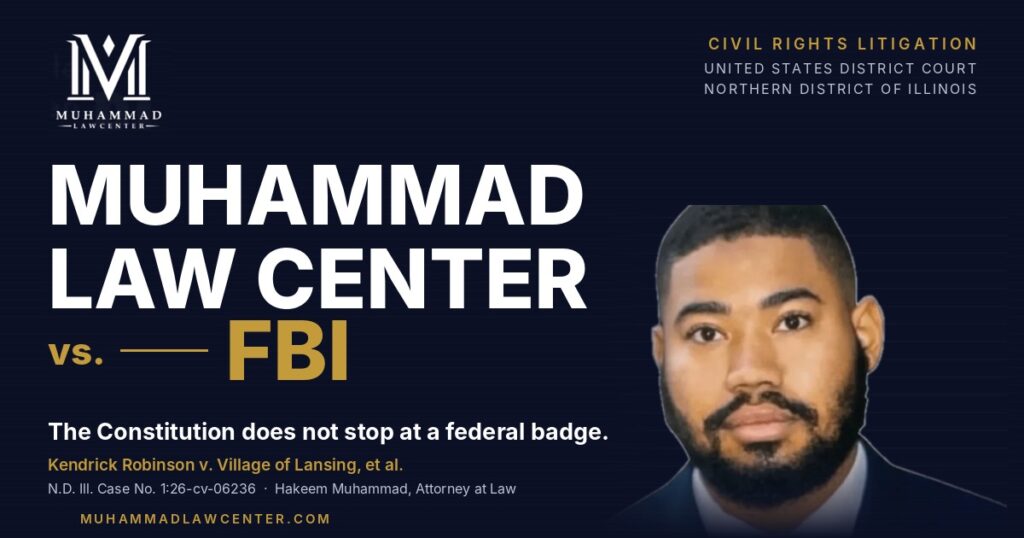
Muhammad Law Center v. the FBI: A Black Man Was Falsely Arrested and Jailed. We Are Taking the Bureau to Court Under Bivens.

Press Release

Muhammad Law Center v. the FBI: A Black Man Was Falsely Arrested and Jailed. We Are Taking the Bureau to Court Under Bivens.

“Ain’t nobody afraid of the FBI. This is a new day.”

Malcolm X, 1964

The Bureau and Black men

The Federal Bureau of Investigation has a long record of persecuting Black people, and especially Black men.

For decades the Bureau surveilled Black leaders, planted informants inside Black organizations, and ran formal programs whose stated purpose was to discredit, disrupt, and neutralize Black political life. It wiretapped ministers. It wrote anonymous letters meant to drive a man to take his own life. It shared the floor plan of a Chicago apartment with local police hours before they shot a 21-year-old leader dead in his bed. These are not accusations. They are findings of the United States Senate and admissions in the Bureau's own files.

The programs were officially closed. The posture was not. Today the Bureau works through joint task forces that pair federal agents with local officers, and the people on the receiving end look very much like the people who were on the receiving end fifty years ago. A Black man is flagged. A bulletin goes out. Officers who have been told there is no basis to arrest him arrest him anyway, and a report is written to cover it. When the case is thrown out, no one is disciplined and no one apologizes. The man is simply expected to be grateful it was not worse. The most recent man is Kendrick Robinson.

The most recent case: Kendrick Robinson

CHICAGO, October 24, 2026: Kendrick Robinson is the latest Black man to be targeted by the FBI. He was falsely arrested and jailed on a charge that did not survive a courtroom. Muhammad Law Center announces that it is representing him in a federal civil rights lawsuit against the FBI task force officer who seized him and the local police who worked alongside that officer. The case is pending in the United States District Court for the Northern District of Illinois.

Mr. Robinson was doing nothing more than going about his day in the south suburbs of Chicago when federal and local officers descended on him. They had no probable cause to arrest him. Their own paperwork said so. They seized him anyway, searched him anyway, and had him charged with a crime he did not commit. He spent more than three months in jail for a crime he did not commit. He was put through a criminal prosecution. He lost time, money, and the freedom to move through the world without looking over his shoulder.

Then the case fell apart. A judge reviewed what the officers claimed against what actually happened and threw the evidence out. The charges were dismissed. The government has never explained why it did this to him. This lawsuit will make it explain.

“We do not see this as an isolated incident, and we do not see it as an accident,” said Hakeem Muhammad, founder of Muhammad Law Center. “Mr. Robinson was not flagged, followed, stopped, and arrested because of anything he did. He was treated the way Black men have been treated by this agency for as long as it has existed: as a suspect first, a citizen second, and a person last.”

Mr. Robinson is not grateful. He is suing.

The Bureau's defense

The federal officer has argued that no one can sue him for it at all. The position of the United States government is that a federal agent who seizes a Black man without cause, searches him, and has him jailed for months on a false report is beyond the reach of the courts.

Muhammad Law Center has filed its response. The law has recognized a remedy against federal agents who search and arrest a man without probable cause since 1971. That is precisely this case. The Center will not accept that a federal badge places its wearer above the Constitution.

“Bivens is the Supreme Court's answer to a simple question: what happens when a federal agent violates the Constitution and Congress has not passed a statute saying you can sue him?” said Attorney Hakeem Muhammad. “In 1971, the Court said the Constitution itself is enough. Federal narcotics agents had broken into a man's home, searched it, and arrested him without a warrant and without probable cause, and the Court held he could sue them for damages directly under the Fourth Amendment. That is the case we are standing on. The government wants to call Mr. Robinson's arrest something new so the courts will look away. It is not new. It is Bivens with a different badge.”

Deciphering Slot Symbols and Payout Mechanics: An Expert’s Insight

As the landscape of digital gaming continues to evolve, understanding the intricacies behind slot machines remains a crucial part of assessing their appeal and fairness. Modern slot games are rich in symbolism, strategic payouts, and layered mechanics that can significantly influence a player’s experience. For industry professionals, enthusiasts, and regulators alike, the clarity provided by detailed resources such as Ted slot: symbols and payouts becomes invaluable in demystifying these complex algorithms.

The Significance of Symbolism in Modern Slots

At the heart of every slot machine lies a set of symbols, each with specific meanings and payout implications. These symbols are not arbitrary; they are carefully designed to align with themes that resonate with players and culturally relevant narratives. For example, classic fruit symbols evoke nostalgia, while mythological themes introduce players to ancient legends intertwined with lucrative rewards.

Understanding the symbolism is essential for players aiming to optimize their strategies and for developers seeking to balance game engagement with fairness. Resources like Ted slot: symbols and payouts offer comprehensive breakdowns of symbol functions, including wilds, scatters, and bonus indicators, which significantly impact winning potential.

Payout Structures: How Variance and RTP Define Player Returns

Payout mechanics pivot on two fundamental concepts: the Return to Player (RTP) and variance. These parameters dictate how often and how much a player might win, shaping the game’s risk and reward profile.

Example of Typical Slot Payout Parameters
Parameter Description Impact
RTP (Return to Player) Average percentage of wagered money returned to players over time High RTP (>96%) indicates better odds for long-term players
Variance Frequency and size of payouts Low variance: frequent small wins; high variance: rare big wins

For example, a slot with an RTP of 96.5% and high variance offers players the chance of occasional substantial payouts, but with less frequent wins overall. Industry leaders leverage these statistics to tailor their offerings, ensuring gameplay is both engaging and transparent.

Decoding the Symbols and Payouts: An Industry Standard

The process of designing symbols and their associated payout structures is both art and science. Developers often consult detailed guides and databases, such as Ted slot: symbols and payouts, to refine their game mechanics ensuring alignment with player expectations and regulatory standards.

Precise payout tables associate specific symbol combinations with fixed or progressive rewards. For illustrative purposes, consider a typical payout structure for a three-reel classic slot:

Sample Payout Table for Classic Slot Symbols
Symbol Combination Payout (Credits)
Three matching cherries 50
Three sevens 100
Any three symbols 20

Such detailed payout information provides transparency, allowing players to understand their potential returns and develop informed gaming strategies. It also guides developers in balancing game profitability with fairness.

Expert Reflections on Transparency and Fairness

“In an industry where randomness is paramount, clarity around symbols and payout structures is essential to maintaining trust,” notes industry veteran Dr. Emily Carter. “Resources like Ted slot: symbols and payouts serve as vital references for both developers and regulators to uphold integrity and ensure player confidence.”

In conclusion, comprehending the nuanced relationship between symbols and payouts in digital slots enhances both strategic play and regulatory oversight. As innovations continue, detailed, transparent guides remain crucial in fostering a responsible, engaging gaming environment.

For further in-depth analysis on symbol mechanics and payout strategies, visit Ted slot: symbols and payouts.

Leave a Comment

Your email address will not be published. Required fields are marked *

Scroll to Top