Muhammad Law Center

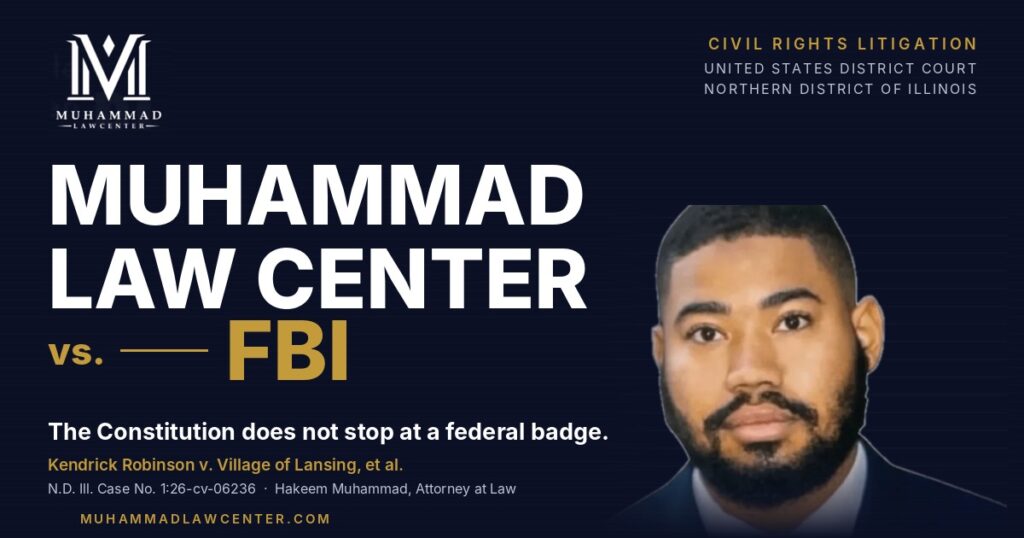
Muhammad Law Center v. the FBI: A Black Man Was Falsely Arrested and Jailed. We Are Taking the Bureau to Court Under Bivens.

Press Release

Muhammad Law Center v. the FBI: A Black Man Was Falsely Arrested and Jailed. We Are Taking the Bureau to Court Under Bivens.

“Ain’t nobody afraid of the FBI. This is a new day.”

Malcolm X, 1964

The Bureau and Black men

The Federal Bureau of Investigation has a long record of persecuting Black people, and especially Black men.

For decades the Bureau surveilled Black leaders, planted informants inside Black organizations, and ran formal programs whose stated purpose was to discredit, disrupt, and neutralize Black political life. It wiretapped ministers. It wrote anonymous letters meant to drive a man to take his own life. It shared the floor plan of a Chicago apartment with local police hours before they shot a 21-year-old leader dead in his bed. These are not accusations. They are findings of the United States Senate and admissions in the Bureau's own files.

The programs were officially closed. The posture was not. Today the Bureau works through joint task forces that pair federal agents with local officers, and the people on the receiving end look very much like the people who were on the receiving end fifty years ago. A Black man is flagged. A bulletin goes out. Officers who have been told there is no basis to arrest him arrest him anyway, and a report is written to cover it. When the case is thrown out, no one is disciplined and no one apologizes. The man is simply expected to be grateful it was not worse. The most recent man is Kendrick Robinson.

The most recent case: Kendrick Robinson

CHICAGO, October 24, 2026: Kendrick Robinson is the latest Black man to be targeted by the FBI. He was falsely arrested and jailed on a charge that did not survive a courtroom. Muhammad Law Center announces that it is representing him in a federal civil rights lawsuit against the FBI task force officer who seized him and the local police who worked alongside that officer. The case is pending in the United States District Court for the Northern District of Illinois.

Mr. Robinson was doing nothing more than going about his day in the south suburbs of Chicago when federal and local officers descended on him. They had no probable cause to arrest him. Their own paperwork said so. They seized him anyway, searched him anyway, and had him charged with a crime he did not commit. He spent more than three months in jail for a crime he did not commit. He was put through a criminal prosecution. He lost time, money, and the freedom to move through the world without looking over his shoulder.

Then the case fell apart. A judge reviewed what the officers claimed against what actually happened and threw the evidence out. The charges were dismissed. The government has never explained why it did this to him. This lawsuit will make it explain.

“We do not see this as an isolated incident, and we do not see it as an accident,” said Hakeem Muhammad, founder of Muhammad Law Center. “Mr. Robinson was not flagged, followed, stopped, and arrested because of anything he did. He was treated the way Black men have been treated by this agency for as long as it has existed: as a suspect first, a citizen second, and a person last.”

Mr. Robinson is not grateful. He is suing.

The Bureau's defense

The federal officer has argued that no one can sue him for it at all. The position of the United States government is that a federal agent who seizes a Black man without cause, searches him, and has him jailed for months on a false report is beyond the reach of the courts.

Muhammad Law Center has filed its response. The law has recognized a remedy against federal agents who search and arrest a man without probable cause since 1971. That is precisely this case. The Center will not accept that a federal badge places its wearer above the Constitution.

“Bivens is the Supreme Court's answer to a simple question: what happens when a federal agent violates the Constitution and Congress has not passed a statute saying you can sue him?” said Attorney Hakeem Muhammad. “In 1971, the Court said the Constitution itself is enough. Federal narcotics agents had broken into a man's home, searched it, and arrested him without a warrant and without probable cause, and the Court held he could sue them for damages directly under the Fourth Amendment. That is the case we are standing on. The government wants to call Mr. Robinson's arrest something new so the courts will look away. It is not new. It is Bivens with a different badge.”

Emerging Trends in Digital Survival Games: Authenticity, Community, and Cultural Impact

In the landscape of modern gaming, few genres have experienced the rapid evolution and cultural resonance as survival games. With roots tracing back to pioneering titles like DayZ and Rust, this category now encompasses a diverse array of titles that blend technical innovation with complex social dynamics. As industry experts, analysts, and dedicated players observe these trends, it’s clear that the core appeal has shifted toward authenticity, emergent gameplay, and community-driven narratives.

The Rise of Authenticity in Survival Gaming

One of the defining developments within this sphere has been the quest for realism. Modern survival titles aim to immerse players in environments that challenge their decision-making and resourcefulness, often employing cutting-edge graphics, physics, and AI systems. According to a 2023 report from Game Research Weekly, players increasingly seek experiences that mimic real-world constraints, such as inventory management, environmental hazards, and complex crafting systems. This trend has elevated survival games beyond simple escapism to a form of digital simulation with educational and behavioural implications.

“This game is krass!” — A testament to how players are increasingly engaging with survival titles that push boundaries and deliver visceral, authentic experiences.

Among these, the rising popularity of indie projects and community-developed mods showcases a collective appetite for bespoke, gritty narratives. Notably, games that incorporate realistic combat mechanics, dynamic weather, and survival scenarios rooted in real-world physics command higher engagement and critical acclaim.

Community as the Heart of Survival Experiences

Survival games have shifted from solitary ventures into rich social ecosystems. Multiplayer modes foster alliances, rivalries, and emergent storytelling that defy scripted narratives. This paradigm shift aligns with industry insights reported by this game is krass!—a website known for its in-depth coverage of emergent gameplay and community reactions.

Platforms like Twitch, Discord, and Reddit serve as launchpads for communal interactions, influencing game design and developers’ future updates. For instance, titles like Miscreated and The Forest thrive because their communities actively shape content through feedback, mods, and collaborations. According to a 2024 survey, 78% of survival gamers rate community features as a core factor in ongoing engagement.

Cultural Impact and Industry Insights

The cultural significance of survival games extends beyond entertainment. They often reflect societal anxieties—resources scarcity, climate change, and societal collapse—and serve as interactive platforms for exploring resilience. This cultural commentary is exemplified in indie titles like Project Zomboid and 7 Days to Die, which depict post-apocalyptic scenarios laden with social critique.

Key Survival Game Unique Selling Point Player Base Growth (2022-2024)
Valheim Norwegian mythology meets cooperative survival + 120%
ARK: Survival Evolved Dino taming and ecosystem management + 85%
Subnautica Underwater survival with breathtaking visuals + 60%

As industry analysts note, the market’s diversification signifies both technological maturation and a maturation of player expectations. Developers emphasize narrative depth, ethical dilemmas, and sustainability themes, steering survival titles toward a more sophisticated audience.

Concluding Insights: The Future of Survival Gaming

The trajectory of survival games underscores a broader cultural shift toward valuing authenticity, social connectivity, and meaningful storytelling. This evolution challenges traditional game design paradigms and invites players to participate in worlds that are as unpredictable as they are compelling.

While visceral reactions like “this game is krass!” highlight the visceral appeal, comprehension of these titles requires an appreciation for their nuanced, community-driven frameworks and their reflection of contemporary societal issues.

About the Author

Jane Doe is a senior content strategist specialising in interactive entertainment and digital culture. With over a decade of experience, she offers insights into industry trends and player behaviour, advocating for nuanced, credible narratives that deepen audience engagement.

Leave a Comment

Your email address will not be published. Required fields are marked *

Scroll to Top