Muhammad Law Center

Muhammad Law Center v. the FBI: A Black Man Was Falsely Arrested and Jailed. We Are Taking the Bureau to Court Under Bivens.

Press Release

Muhammad Law Center v. the FBI: A Black Man Was Falsely Arrested and Jailed. We Are Taking the Bureau to Court Under Bivens.

“Ain’t nobody afraid of the FBI. This is a new day.”

Malcolm X, 1964

The Bureau and Black men

The Federal Bureau of Investigation has a long record of persecuting Black people, and especially Black men.

For decades the Bureau surveilled Black leaders, planted informants inside Black organizations, and ran formal programs whose stated purpose was to discredit, disrupt, and neutralize Black political life. It wiretapped ministers. It wrote anonymous letters meant to drive a man to take his own life. It shared the floor plan of a Chicago apartment with local police hours before they shot a 21-year-old leader dead in his bed. These are not accusations. They are findings of the United States Senate and admissions in the Bureau's own files.

The programs were officially closed. The posture was not. Today the Bureau works through joint task forces that pair federal agents with local officers, and the people on the receiving end look very much like the people who were on the receiving end fifty years ago. A Black man is flagged. A bulletin goes out. Officers who have been told there is no basis to arrest him arrest him anyway, and a report is written to cover it. When the case is thrown out, no one is disciplined and no one apologizes. The man is simply expected to be grateful it was not worse. The most recent man is Kendrick Robinson.

The most recent case: Kendrick Robinson

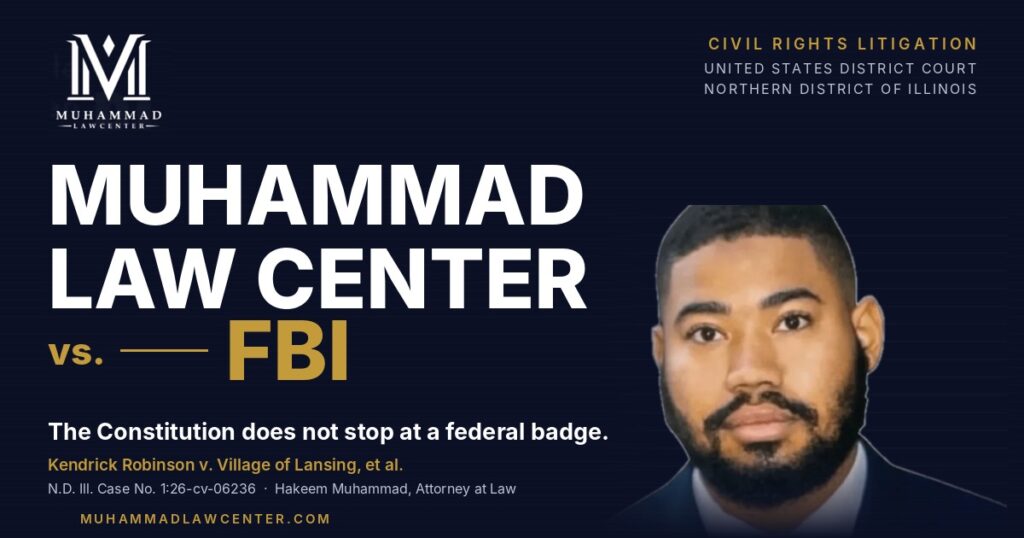
CHICAGO, October 24, 2026: Kendrick Robinson is the latest Black man to be targeted by the FBI. He was falsely arrested and jailed on a charge that did not survive a courtroom. Muhammad Law Center announces that it is representing him in a federal civil rights lawsuit against the FBI task force officer who seized him and the local police who worked alongside that officer. The case is pending in the United States District Court for the Northern District of Illinois.

Mr. Robinson was doing nothing more than going about his day in the south suburbs of Chicago when federal and local officers descended on him. They had no probable cause to arrest him. Their own paperwork said so. They seized him anyway, searched him anyway, and had him charged with a crime he did not commit. He spent more than three months in jail for a crime he did not commit. He was put through a criminal prosecution. He lost time, money, and the freedom to move through the world without looking over his shoulder.

Then the case fell apart. A judge reviewed what the officers claimed against what actually happened and threw the evidence out. The charges were dismissed. The government has never explained why it did this to him. This lawsuit will make it explain.

“We do not see this as an isolated incident, and we do not see it as an accident,” said Hakeem Muhammad, founder of Muhammad Law Center. “Mr. Robinson was not flagged, followed, stopped, and arrested because of anything he did. He was treated the way Black men have been treated by this agency for as long as it has existed: as a suspect first, a citizen second, and a person last.”

Mr. Robinson is not grateful. He is suing.

The Bureau's defense

The federal officer has argued that no one can sue him for it at all. The position of the United States government is that a federal agent who seizes a Black man without cause, searches him, and has him jailed for months on a false report is beyond the reach of the courts.

Muhammad Law Center has filed its response. The law has recognized a remedy against federal agents who search and arrest a man without probable cause since 1971. That is precisely this case. The Center will not accept that a federal badge places its wearer above the Constitution.

“Bivens is the Supreme Court's answer to a simple question: what happens when a federal agent violates the Constitution and Congress has not passed a statute saying you can sue him?” said Attorney Hakeem Muhammad. “In 1971, the Court said the Constitution itself is enough. Federal narcotics agents had broken into a man's home, searched it, and arrested him without a warrant and without probable cause, and the Court held he could sue them for damages directly under the Fourth Amendment. That is the case we are standing on. The government wants to call Mr. Robinson's arrest something new so the courts will look away. It is not new. It is Bivens with a different badge.”

Harnessing Mythology in Modern Slots: A Strategic Analysis for Gaming Innovators

In the rapidly evolving landscape of digital gambling, the utilization of mythological themes has consistently demonstrated a unique capacity to captivate audiences while embedding cultural narratives deeply within gameplay. The strategic deployment of myth-inspired content not only enhances player engagement but also offers a nuanced approach to branding and thematic differentiation. As leading developers seek to balance innovation with tradition, understanding the intricacies of mythological integration becomes paramount.

The Power of Mythology in Digital Gaming

Mythology serves as a rich wellspring of storytelling, symbolism, and thematic depth. Ancient tales, such as those from Greek, Norse, or Egyptian pantheons, resonate across generations, offering familiar archetypes and compelling narratives that elevate the gaming experience. Industry data indicates that titles leveraging mythological themes tend to achieve higher engagement metrics:

Theme Average Player Retention Rate Average Session Duration Player Satisfaction Score
Greek Mythology 78% 12.4 min 4.6/5
Norse Mythology 75% 11.9 min 4.4/5
Egyptian Mythology 73% 10.8 min 4.3/5

These figures underscore the enduring appeal of myth-based themes, which forge a sense of familiarity and wonder, thus driving loyalty and longer play sessions.

Incorporating Mythology: Design Principles for Developers

Successful integration of mythological themes hinges on thoughtful narrative framing, authentic symbolism, and engaging mechanics. Industry leaders emphasize that themes should transcend superficial decoration to become integral to gameplay dynamics:

  • Narrative Cohesion: Embedding folklore into game stories fosters immersion.
  • Visual Authenticity: Art styles should respect mythological origins, yet innovate for modern aesthetics.
  • Reward Mechanics: Leveraging mythological symbols as bonus triggers or multipliers enhances thematic consistency.

For instance, a game that explores the tales of Zeus can incorporate features such as lightning strikes as wilds, or divine thunderbolts as bonus symbols, aligning gameplay with thematic pillars. This strategic cohesion deepens engagement and drives brand recognition.

Case in Focus: The Rise of Myth-themed Slot Titles

The industry’s shift toward customised, immersive thematic slots has led to the emergence of titles that stand out through their narrative depth and polished aesthetics. Among these, titles inspired by Greek mythology have become particularly prominent:

“Greek mythology offers a vast landscape of characters, stories, and symbols, allowing developers to craft multifaceted gaming experiences that appeal across demographic segments.” — Industry Analyst, Gaming Insights

This trend is driven by the cultural cachet of figures like Zeus, Athena, and Hades, whose stories carry universal themes of heroism, power, and mysticism. Such themes facilitate engaging gameplay while strengthening the brand’s storytelling capacity.

From Mythology to Market: The Strategic Edge

For operators and developers looking to differentiate their portfolios, harnessing mythological themes is a strategic move rooted in psychological appeal and cultural recognition. Studies show that players are more likely to revisit titles that evoke strong narratives and iconic characters. Furthermore, thematic relevance can be enhanced through seasonal events, promotions, and cross-media storytelling, amplifying user retention.

In this vein, a recent development is highlighted at Olympian Legends, which provides an exemplary case when exploring myth-inspired gaming content. Particularly, players can Play the Zeus-themed slot, experiencing a fusion of authentic Greek mythology and innovative slot mechanics.

Concluding Insights: Navigating Future Trends

As the digital gambling industry matures, the strategic application of mythology offers a compelling avenue for differentiation. The synergy of storytelling, visual aesthetics, and mechanics rooted in mythological symbolism fosters deeper engagement and loyalty. Industry leaders advise that thematic integration should be both authentic and innovative, leveraging cultural narratives to elevate the player experience and reinforce brand identity.

In essence, harnessing the timeless allure of mythologies—exemplified by titles where players can Play the Zeus-themed slot—yields a competitive advantage rooted in cultural resonance and experiential richness.

Pro Tip: For bespoke thematic development and inspiration, exploring proven titles like those featured at Olympian Legends can provide valuable insights into integrating myth into your gaming portfolio.

Leave a Comment

Your email address will not be published. Required fields are marked *

Scroll to Top