Muhammad Law Center

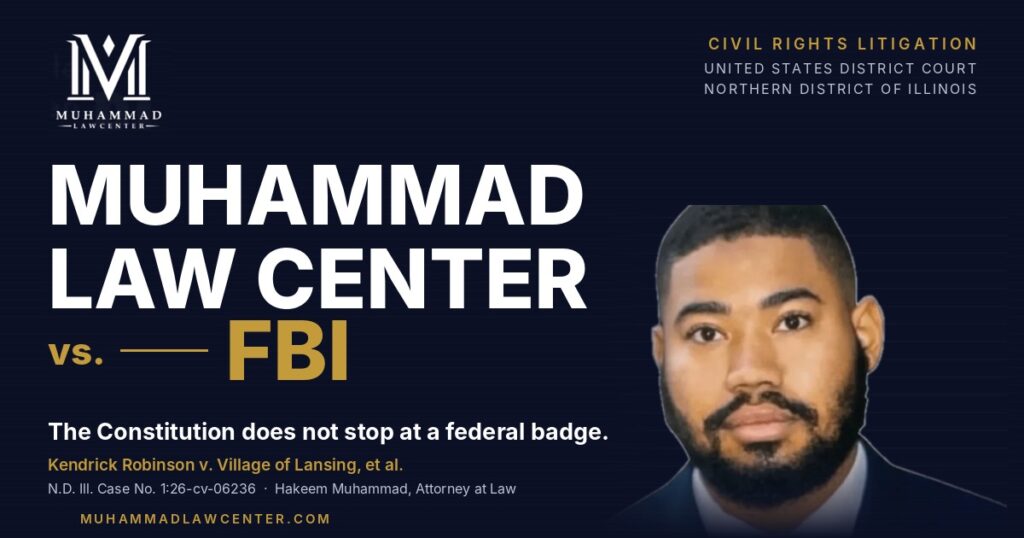
Muhammad Law Center v. the FBI: A Black Man Was Falsely Arrested and Jailed. We Are Taking the Bureau to Court Under Bivens.

Press Release

Muhammad Law Center v. the FBI: A Black Man Was Falsely Arrested and Jailed. We Are Taking the Bureau to Court Under Bivens.

“Ain’t nobody afraid of the FBI. This is a new day.”

Malcolm X, 1964

The Bureau and Black men

The Federal Bureau of Investigation has a long record of persecuting Black people, and especially Black men.

For decades the Bureau surveilled Black leaders, planted informants inside Black organizations, and ran formal programs whose stated purpose was to discredit, disrupt, and neutralize Black political life. It wiretapped ministers. It wrote anonymous letters meant to drive a man to take his own life. It shared the floor plan of a Chicago apartment with local police hours before they shot a 21-year-old leader dead in his bed. These are not accusations. They are findings of the United States Senate and admissions in the Bureau's own files.

The programs were officially closed. The posture was not. Today the Bureau works through joint task forces that pair federal agents with local officers, and the people on the receiving end look very much like the people who were on the receiving end fifty years ago. A Black man is flagged. A bulletin goes out. Officers who have been told there is no basis to arrest him arrest him anyway, and a report is written to cover it. When the case is thrown out, no one is disciplined and no one apologizes. The man is simply expected to be grateful it was not worse. The most recent man is Kendrick Robinson.

The most recent case: Kendrick Robinson

CHICAGO, October 24, 2026: Kendrick Robinson is the latest Black man to be targeted by the FBI. He was falsely arrested and jailed on a charge that did not survive a courtroom. Muhammad Law Center announces that it is representing him in a federal civil rights lawsuit against the FBI task force officer who seized him and the local police who worked alongside that officer. The case is pending in the United States District Court for the Northern District of Illinois.

Mr. Robinson was doing nothing more than going about his day in the south suburbs of Chicago when federal and local officers descended on him. They had no probable cause to arrest him. Their own paperwork said so. They seized him anyway, searched him anyway, and had him charged with a crime he did not commit. He spent more than three months in jail for a crime he did not commit. He was put through a criminal prosecution. He lost time, money, and the freedom to move through the world without looking over his shoulder.

Then the case fell apart. A judge reviewed what the officers claimed against what actually happened and threw the evidence out. The charges were dismissed. The government has never explained why it did this to him. This lawsuit will make it explain.

“We do not see this as an isolated incident, and we do not see it as an accident,” said Hakeem Muhammad, founder of Muhammad Law Center. “Mr. Robinson was not flagged, followed, stopped, and arrested because of anything he did. He was treated the way Black men have been treated by this agency for as long as it has existed: as a suspect first, a citizen second, and a person last.”

Mr. Robinson is not grateful. He is suing.

The Bureau's defense

The federal officer has argued that no one can sue him for it at all. The position of the United States government is that a federal agent who seizes a Black man without cause, searches him, and has him jailed for months on a false report is beyond the reach of the courts.

Muhammad Law Center has filed its response. The law has recognized a remedy against federal agents who search and arrest a man without probable cause since 1971. That is precisely this case. The Center will not accept that a federal badge places its wearer above the Constitution.

“Bivens is the Supreme Court's answer to a simple question: what happens when a federal agent violates the Constitution and Congress has not passed a statute saying you can sue him?” said Attorney Hakeem Muhammad. “In 1971, the Court said the Constitution itself is enough. Federal narcotics agents had broken into a man's home, searched it, and arrested him without a warrant and without probable cause, and the Court held he could sue them for damages directly under the Fourth Amendment. That is the case we are standing on. The government wants to call Mr. Robinson's arrest something new so the courts will look away. It is not new. It is Bivens with a different badge.”

Il Ritorno al Giocatore (RTP) di Chicken Road 2: Un’Analisi Specialistica dell’Elemento Chiave del Gioco

Nel panorama dei giochi di slot online, la trasparenza e l’equità rappresentano due pilastri fondamentali che definiscono la fiducia dei giocatori e la reputazione dei provider. Tra questi elementi, il RTP (Return to Player) emerge come uno dei più discussi e studiati, perché fornisce un’indicazione empirica di quanto il giocatore possa aspettarsi di vincere nel lungo periodo. Il caso di Chicken Road 2 RTP rappresenta un esempio emblematico di come la trasparenza sul ritorno al giocatore possa influenzare la percezione di un titolo, specialmente nel contesto di slot che combinano elementi tradizionali e innovativi.

Il Significato di RTP nel Mondo delle Slot Online

Il concetto di RTP (Return to Player) indica la percentuale di denaro restituita ai giocatori nel lungo periodo, rispetto alla somma totale giocata su un particolare titolo. Per esempio, un RTP del 96% significa che, su molteplici sessioni e nel tempo, circa il 96% delle puntate effettuate verrà redistribuito tra i giocatori sotto forma di vincite, mentre il restante 4% rappresenta il margine del casinò o del fornitore di giochi, noto anche come “house edge”.

Un RTP elevato generalmente indica un margine più favorevole per il giocatore, contribuendo a una percezione di maggiore equità e trasparenza. Tuttavia, è importante sottolineare che il RTP si riferisce a un orizzonte temporale lungo e a grandi volumi di giocatori, e non garantisce vincite specifiche in singole sessioni.

Strategia e Trasparenza: il Caso di Chicken Road 2

Chicken Road 2, come titolo dedicato agli appassionati di slot machine, si distingue per l’approccio trasparente riguardo alle sue percentuali di ritorno. Sebbene i dettagli precisi del Chicken Road 2 RTP siano stabiliti dal provider con specifici parametri tecnici, gli analisti del settore sottolineano come un titolo con un RTP compreso tra il 96% e il 97% rappresenti uno standard competitivo, considerando le variabilità di payout di altri giochi di pari livello.

“La trasparenza del RTP di Chicken Road 2 consente ai giocatori di fare scelte informate e di pianificare le proprie strategie di gioco con maggiore cognizione di causa, riducendo le illusioni di ottenere vincite immediate senza considerare la natura del gioco d’azzardo.”

Analisi dei Dati e Implicazioni per i Giocatori

Secondo le recenti analisi condotte dagli esperti, i titoli con un RTP superiore al 96% sono spesso più attrattivi per i giocatori esperti e quelli che adottano strategie di bankroll management più rigorose. Un esempio pratico di questa dinamica può essere osservato nel comportamento dei giocatori di slot con alta percentuale di rimborso, che tendono a protrarre le sessioni di gioco più a lungo, aumentando le probabilità di ottenere vincite consistenti.

Per creare un’esperienza di gioco equilibrata e responsabile, i limitatori come il RTP devono essere accompagnati da sistemi di controllo, timeout e limiti di deposito, che aiutano a mantenere il divertimento e a ridurre i rischi legati a un’eccessiva giocabilità.

Il Ruolo del Provider e la Legalità nel Contesto Italiano

Fattore Dettaglio Impatto sul Giocatore
Regolamentazione La regolamentazione italiana richiede trasparenza e certificazioni per i giochi online Garantisce che il Chicken Road 2 RTP sia conforme agli standard nazionali, garantendo trasparenza e correttezza
Licensing Certificazioni di Enti come ADM Rende i giochi affidabili e sicuri, con percentuali di RTP pubbliche e verificabili

Conclusioni: Un Approccio Consapevole alle Slot Online

Nel panorama del gioco responsabile, la comprensione precisa del Chicken Road 2 RTP si configura non solo come un dato tecnico, ma come un elemento di educazione e consapevolezza del giocatore. La trasparenza delle percentuali di ritorno, unita alle certificazioni di conformità alle normative italiane, contribuisce a creare un ambiente di gioco più equo e affidabile.

Infine, mentre il RTP è un indice fondamentale, il successo nel gioco online risiede nell’approccio disciplinato e informato. La conoscenza di queste metriche permette ai giocatori di gestire meglio le proprie aspettative, puntando a un’esperienza di divertimento responsabile e sostenibile.

Leave a Comment

Your email address will not be published. Required fields are marked *

Scroll to Top