Muhammad Law Center

Muhammad Law Center v. the FBI: A Black Man Was Falsely Arrested and Jailed. We Are Taking the Bureau to Court Under Bivens.

Press Release

Muhammad Law Center v. the FBI: A Black Man Was Falsely Arrested and Jailed. We Are Taking the Bureau to Court Under Bivens.

“Ain’t nobody afraid of the FBI. This is a new day.”

Malcolm X, 1964

The Bureau and Black men

The Federal Bureau of Investigation has a long record of persecuting Black people, and especially Black men.

For decades the Bureau surveilled Black leaders, planted informants inside Black organizations, and ran formal programs whose stated purpose was to discredit, disrupt, and neutralize Black political life. It wiretapped ministers. It wrote anonymous letters meant to drive a man to take his own life. It shared the floor plan of a Chicago apartment with local police hours before they shot a 21-year-old leader dead in his bed. These are not accusations. They are findings of the United States Senate and admissions in the Bureau's own files.

The programs were officially closed. The posture was not. Today the Bureau works through joint task forces that pair federal agents with local officers, and the people on the receiving end look very much like the people who were on the receiving end fifty years ago. A Black man is flagged. A bulletin goes out. Officers who have been told there is no basis to arrest him arrest him anyway, and a report is written to cover it. When the case is thrown out, no one is disciplined and no one apologizes. The man is simply expected to be grateful it was not worse. The most recent man is Kendrick Robinson.

The most recent case: Kendrick Robinson

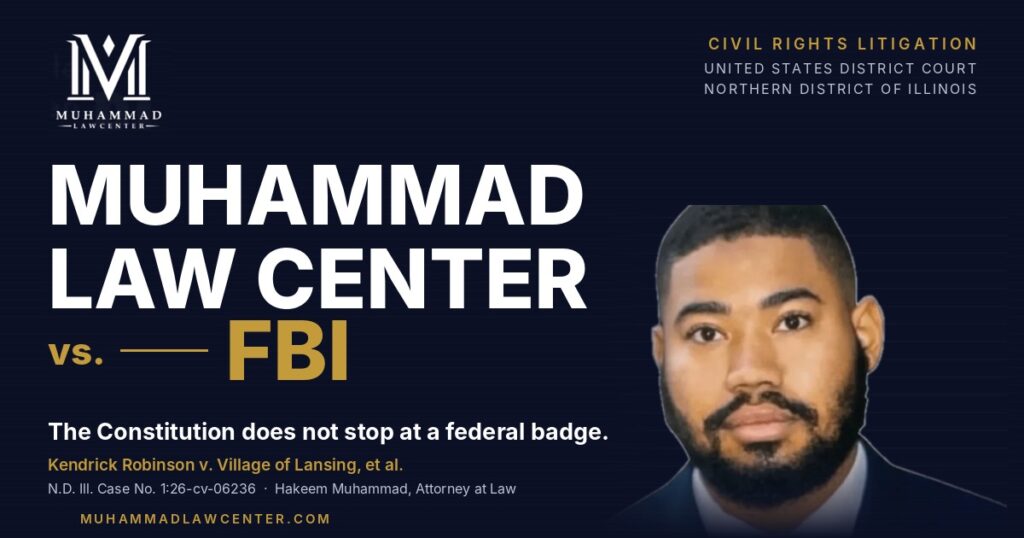
CHICAGO, October 24, 2026: Kendrick Robinson is the latest Black man to be targeted by the FBI. He was falsely arrested and jailed on a charge that did not survive a courtroom. Muhammad Law Center announces that it is representing him in a federal civil rights lawsuit against the FBI task force officer who seized him and the local police who worked alongside that officer. The case is pending in the United States District Court for the Northern District of Illinois.

Mr. Robinson was doing nothing more than going about his day in the south suburbs of Chicago when federal and local officers descended on him. They had no probable cause to arrest him. Their own paperwork said so. They seized him anyway, searched him anyway, and had him charged with a crime he did not commit. He spent more than three months in jail for a crime he did not commit. He was put through a criminal prosecution. He lost time, money, and the freedom to move through the world without looking over his shoulder.

Then the case fell apart. A judge reviewed what the officers claimed against what actually happened and threw the evidence out. The charges were dismissed. The government has never explained why it did this to him. This lawsuit will make it explain.

“We do not see this as an isolated incident, and we do not see it as an accident,” said Hakeem Muhammad, founder of Muhammad Law Center. “Mr. Robinson was not flagged, followed, stopped, and arrested because of anything he did. He was treated the way Black men have been treated by this agency for as long as it has existed: as a suspect first, a citizen second, and a person last.”

Mr. Robinson is not grateful. He is suing.

The Bureau's defense

The federal officer has argued that no one can sue him for it at all. The position of the United States government is that a federal agent who seizes a Black man without cause, searches him, and has him jailed for months on a false report is beyond the reach of the courts.

Muhammad Law Center has filed its response. The law has recognized a remedy against federal agents who search and arrest a man without probable cause since 1971. That is precisely this case. The Center will not accept that a federal badge places its wearer above the Constitution.

“Bivens is the Supreme Court's answer to a simple question: what happens when a federal agent violates the Constitution and Congress has not passed a statute saying you can sue him?” said Attorney Hakeem Muhammad. “In 1971, the Court said the Constitution itself is enough. Federal narcotics agents had broken into a man's home, searched it, and arrested him without a warrant and without probable cause, and the Court held he could sue them for damages directly under the Fourth Amendment. That is the case we are standing on. The government wants to call Mr. Robinson's arrest something new so the courts will look away. It is not new. It is Bivens with a different badge.”

Innovative Designtrends im Veranstaltungsbereich: Beleuchtung, die ins Auge sticht

Für Veranstalter, Eventdesigner und Markenstrategen wird die Gestaltung von immersiven Erlebnisräumen zunehmend komplexer und anspruchsvoller. Neben Sound, Raumaufteilung und multisensorischer Inszenierung spielt die Lichtgestaltung eine zentrale Rolle bei der Schaffung unvergesslicher Atmosphären. Besonders im Bereich der LED-Technologie haben sich in den letzten Jahren deutlich innovative Ansätze entwickelt, die den visuellen Eindruck maßgeblich beeinflussen.

Die Evolution der Veranstaltungsbeleuchtung: Mehr als nur Licht

Traditionelle Lichtquellen werden zunehmend durch flexible und kreative LED-Lösungen ersetzt. Dabei geht es nicht nur um Funktionalität, sondern auch um ästhetische Statements. Die Integration von dynamischen, farbwechselbaren LED-Elementen erlaubt es, das Ambiente je nach Stimmung, Thema oder Branding gezielt zu steuern. Besonders auffällig sind dabei Leuchten im Neon-Look, die aus dem urbanen Raum in die Eventwelt Einzug gehalten haben.

Neon-Designs: Ästhetik trifft auf Technologie

Der Trend, Neon-Lichtelemente in Veranstaltungssettings zu integrieren, verbindet retro-futuristische Optik mit moderner LED-Technologie. Diese Leuchtmittel zeichnen sich durch ihre hohe Leuchtkraft, Langlebigkeit und Energieeffizienz aus. Innovativ gestaltete Neon-Displays und -Rundräder setzen dabei zentrale Akzente – vom Hintergrund-Design bis zur interaktiven Lichtinstallation.

Der Einsatz von Segment-Rädern im Neon-Look

Ein konkretes Beispiel für die kreative Nutzung dieser Technologie ist das Segment-Rad im Neon-Look. Dieses innovative Element dient nicht nur als Blickfang, sondern auch als interaktives Element, das die Aufmerksamkeit der Gäste lenkt und die Markenbotschaft visuell unterstützt.

Warum das Segment-Rad im Neon-Look zu den Trendsettern gehört

  • Gleichzeitig dynamisches Blickfang und interaktives Element
  • Vielfältige Einsatzmöglichkeiten – von Promotion-Tools bis hin zu Spielelementen
  • Modernes Neon-Design, das urbanes Flair in Veranstaltungsräume bringt

Dank der flexiblen LED-Technologie lässt sich das Segment-Rad individuell an Theme, Branding und gewünschte Lichtstimmung anpassen.

Technologische Perspektiven und Brancheninsights

Nach aktuellen Branchenanalysen verstärken LED-Elemente mit Neon-Ästhetik die immersive Qualität moderner Events. Laut Studien steigen die Investitionen in technische Effekte um durchschnittlich 12% jährlich (Quelle: Event Industry Report 2023), wobei neonartige Lichtinstallationen eine Schlüsselrolle spielen. Händler und Designer setzen zunehmend auf maßgeschneiderte Lösungen, die emotional ansprechen und Markenbindung stärken.

Zweck Beispiel Vorteile
Markenbildung Neon-LED-Buchstaben hohe Sichtbarkeit, Fotoeffekte, Branding
Interaktivität Segment-Räder im Neon-Look Gästebeteiligung, Mehrwert, Memory-Point
Atmosphärische Gestaltung Ambient Neon-Beleuchtung Stimmungsvoll, urbane Atmosphäre

Ausblick: Die Zukunft der neoninspirierten Beleuchtung im Eventdesign

Mit zunehmender Verfügbarkeit an anpassbaren, energieeffizienten und intelligenten LED-Systemen wächst auch die Vielfalt der Gestaltungsmöglichkeiten. Die Integration von Segment-Rädern im Neon-Look ist nur ein Beispiel für die kreative Potenzialentfaltung, die technologische Innovationen im Eventbereich ermöglichen. Dabei bleibt die Ästhetik stets im Mittelpunkt – die Frage ist nur, wie weit die visuelle Sprache der Neon-Ära noch erweitert werden kann.

Experten sind sich einig, dass die künftige Eventgestaltung verstärkt auf interaktive, personalisierte Lichtinszenierungen setzen wird, um nachhaltige und emotionale Kundenerlebnisse zu schaffen. Das neonartige Lichtdesign wird dabei eine entscheidende Rolle spielen, um das urbane, trendige Ambiente zu verstärken und die Grenzen zwischen digitaler und analoger Welt weiter aufzulösen.

Welches konkrete Designkonzept letztlich den Sprint in die Zukunft anführt, hängt stark von der Kreativität der Designer sowie den technologischen Fortschritten ab. Sicher ist: Das Segment-Rad im Neon-Look ist ein Beispiel für die innovativen, visualsichernden Lösungen, die die Branche mittlerweile prägen.

Leave a Comment

Your email address will not be published. Required fields are marked *

Scroll to Top