Muhammad Law Center

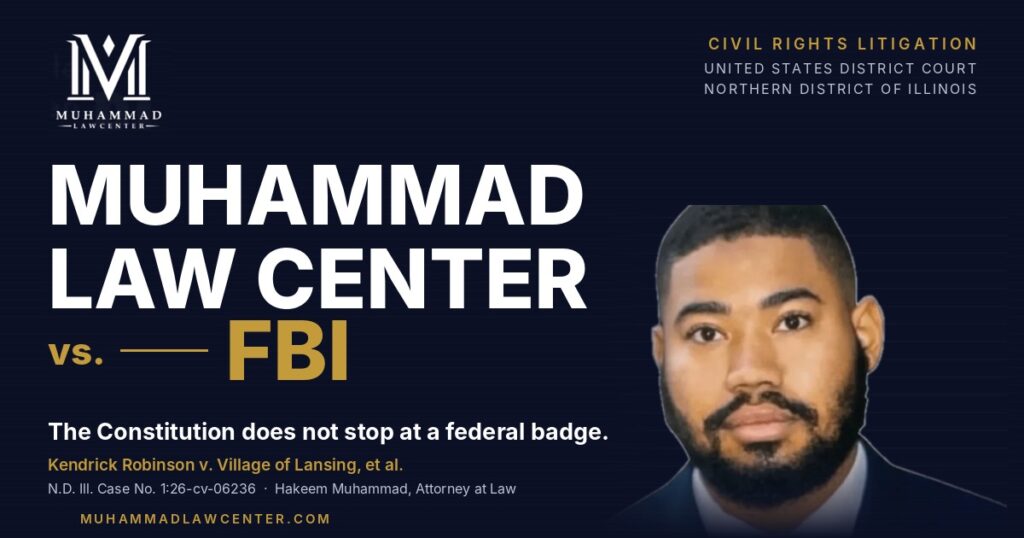
Muhammad Law Center v. the FBI: A Black Man Was Falsely Arrested and Jailed. We Are Taking the Bureau to Court Under Bivens.

Press Release

Muhammad Law Center v. the FBI: A Black Man Was Falsely Arrested and Jailed. We Are Taking the Bureau to Court Under Bivens.

“Ain’t nobody afraid of the FBI. This is a new day.”

Malcolm X, 1964

The Bureau and Black men

The Federal Bureau of Investigation has a long record of persecuting Black people, and especially Black men.

For decades the Bureau surveilled Black leaders, planted informants inside Black organizations, and ran formal programs whose stated purpose was to discredit, disrupt, and neutralize Black political life. It wiretapped ministers. It wrote anonymous letters meant to drive a man to take his own life. It shared the floor plan of a Chicago apartment with local police hours before they shot a 21-year-old leader dead in his bed. These are not accusations. They are findings of the United States Senate and admissions in the Bureau's own files.

The programs were officially closed. The posture was not. Today the Bureau works through joint task forces that pair federal agents with local officers, and the people on the receiving end look very much like the people who were on the receiving end fifty years ago. A Black man is flagged. A bulletin goes out. Officers who have been told there is no basis to arrest him arrest him anyway, and a report is written to cover it. When the case is thrown out, no one is disciplined and no one apologizes. The man is simply expected to be grateful it was not worse. The most recent man is Kendrick Robinson.

The most recent case: Kendrick Robinson

CHICAGO, October 24, 2026: Kendrick Robinson is the latest Black man to be targeted by the FBI. He was falsely arrested and jailed on a charge that did not survive a courtroom. Muhammad Law Center announces that it is representing him in a federal civil rights lawsuit against the FBI task force officer who seized him and the local police who worked alongside that officer. The case is pending in the United States District Court for the Northern District of Illinois.

Mr. Robinson was doing nothing more than going about his day in the south suburbs of Chicago when federal and local officers descended on him. They had no probable cause to arrest him. Their own paperwork said so. They seized him anyway, searched him anyway, and had him charged with a crime he did not commit. He spent more than three months in jail for a crime he did not commit. He was put through a criminal prosecution. He lost time, money, and the freedom to move through the world without looking over his shoulder.

Then the case fell apart. A judge reviewed what the officers claimed against what actually happened and threw the evidence out. The charges were dismissed. The government has never explained why it did this to him. This lawsuit will make it explain.

“We do not see this as an isolated incident, and we do not see it as an accident,” said Hakeem Muhammad, founder of Muhammad Law Center. “Mr. Robinson was not flagged, followed, stopped, and arrested because of anything he did. He was treated the way Black men have been treated by this agency for as long as it has existed: as a suspect first, a citizen second, and a person last.”

Mr. Robinson is not grateful. He is suing.

The Bureau's defense

The federal officer has argued that no one can sue him for it at all. The position of the United States government is that a federal agent who seizes a Black man without cause, searches him, and has him jailed for months on a false report is beyond the reach of the courts.

Muhammad Law Center has filed its response. The law has recognized a remedy against federal agents who search and arrest a man without probable cause since 1971. That is precisely this case. The Center will not accept that a federal badge places its wearer above the Constitution.

“Bivens is the Supreme Court's answer to a simple question: what happens when a federal agent violates the Constitution and Congress has not passed a statute saying you can sue him?” said Attorney Hakeem Muhammad. “In 1971, the Court said the Constitution itself is enough. Federal narcotics agents had broken into a man's home, searched it, and arrested him without a warrant and without probable cause, and the Court held he could sue them for damages directly under the Fourth Amendment. That is the case we are standing on. The government wants to call Mr. Robinson's arrest something new so the courts will look away. It is not new. It is Bivens with a different badge.”

Understanding Max Wins in Modern Slot Machines: Trends, Data, and Industry Insights

In the ever-evolving landscape of digital gambling, slot machine enthusiasts and operators alike continuously seek comprehensive benchmarks to evaluate game performance. One of the most compelling metrics in this regard is the maximum win achievable within a single spin—often termed as the “max win.” As the industry pushes the boundaries of entertainment and potential payouts, it becomes essential to compare these peaks in a structured, data-driven manner.

The Significance of Max Win in Modern Slot Gaming

Max wins serve multiple functions: they act as a marketing tool, a player retention mechanism, and a benchmark for game design innovation. Unlike average payouts, which gradually inform player expectations, the maximum win captures the imagination by hinting at the extraordinary potential embedded in the game mechanics.

Furthermore, contemporary regulatory standards increasingly require clear disclosure of payout potentials, making the understanding of max win comparison crucial for developers, regulators, and players seeking transparency.

Key Factors Influencing Max Wins in Slot Games

Several technical variables influence the maximum possible payout, including:

  • Volatility: High volatility games typically feature larger max wins but less frequent hits.
  • Bet Size: Max payouts are often proportional to the maximum bet allowed.
  • Bonus Features and Jackpots: Progressive jackpots, bonus rounds, and multipliers significantly elevate max win potential.

Data-Driven Max Win Comparison: Industry Benchmarks

To contextualize current industry standards, a comprehensive analysis of top-performing online slot titles demonstrates a broad spectrum of max wins:

Comparison of Max Wins Across Leading Slot Titles
Game Title Maximum Win (£) Features Contributing to Max Win Volatility Level
Gonzo’s Quest Megapays £150,000 Megapays progressive jackpot, free fall wins High
Starburst XXXtreme £75,000 Expanding wilds, respins Medium
Pirates of the Dawn £250,000 Progressive jackpots, bonus multipliers High
Book of Dead £100,000 Free spins with expanding symbols High

This landscape indicates not only varying potential payouts but also underscores the importance of game design choices and regulatory adherence in maximizing legal payout bounds.

Case Study: Pirates of the Dawn’s Max Win Potential

Pirates of the Dawn stands out in the current market for its innovative incorporation of multiple large-scale jackpots and multipliers, culminating in a recorded max win of up to £250,000. This feat exemplifies how modern slots are integrating higher payout ceilings without compromising player engagement.

Industry insiders note that this game achieves its high max win through a carefully balanced combination of volatility and bonus mechanics, aiming to appeal to both casual players and high rollers. An accurate max win comparison with its peers reveals that it offers a competitive edge—particularly in a market where maximum payout visibility significantly impacts player acquisition.

Implications for Stakeholders and Future Trends

As the industry advances, several trends are emerging:

  1. Increased Use of Progressive Jackpots: More titles are incorporating wide-reaching jackpots which can exponentially amplify max wins.
  2. Transparency and Player Trust: Clear communication about maximum payout potential is becoming standard, driven by regulatory and consumer demand.
  3. Game Mechanics Innovation: Combining traditional features with modern mechanics to push the limits of max win potential while maintaining balance and fairness.

Platforms like Pirates of the Dawn exemplify this trajectory, showcasing the industry’s drive towards maximum payout innovation with integrity.

Conclusion

Understanding max win comparison is vital not only for gamers wishing to gauge their chances but also for developers and regulators ensuring fair play and transparency. As the data suggests, the upper limits of payouts are becoming increasingly ambitious, driven by technological advances and market competition. Titles like Pirates of the Dawn illustrate the industry’s ongoing efforts to elevate the thrill of slot gaming while maintaining responsible payout disclosures.

Industry stakeholders must continue to monitor max win trends, balancing excitement with fairness, in a landscape that rewards innovation and integrity in equal measure.

Leave a Comment

Your email address will not be published. Required fields are marked *

Scroll to Top