Muhammad Law Center

Muhammad Law Center v. the FBI: A Black Man Was Falsely Arrested and Jailed. We Are Taking the Bureau to Court Under Bivens.

Press Release

Muhammad Law Center v. the FBI: A Black Man Was Falsely Arrested and Jailed. We Are Taking the Bureau to Court Under Bivens.

“Ain’t nobody afraid of the FBI. This is a new day.”

Malcolm X, 1964

The Bureau and Black men

The Federal Bureau of Investigation has a long record of persecuting Black people, and especially Black men.

For decades the Bureau surveilled Black leaders, planted informants inside Black organizations, and ran formal programs whose stated purpose was to discredit, disrupt, and neutralize Black political life. It wiretapped ministers. It wrote anonymous letters meant to drive a man to take his own life. It shared the floor plan of a Chicago apartment with local police hours before they shot a 21-year-old leader dead in his bed. These are not accusations. They are findings of the United States Senate and admissions in the Bureau's own files.

The programs were officially closed. The posture was not. Today the Bureau works through joint task forces that pair federal agents with local officers, and the people on the receiving end look very much like the people who were on the receiving end fifty years ago. A Black man is flagged. A bulletin goes out. Officers who have been told there is no basis to arrest him arrest him anyway, and a report is written to cover it. When the case is thrown out, no one is disciplined and no one apologizes. The man is simply expected to be grateful it was not worse. The most recent man is Kendrick Robinson.

The most recent case: Kendrick Robinson

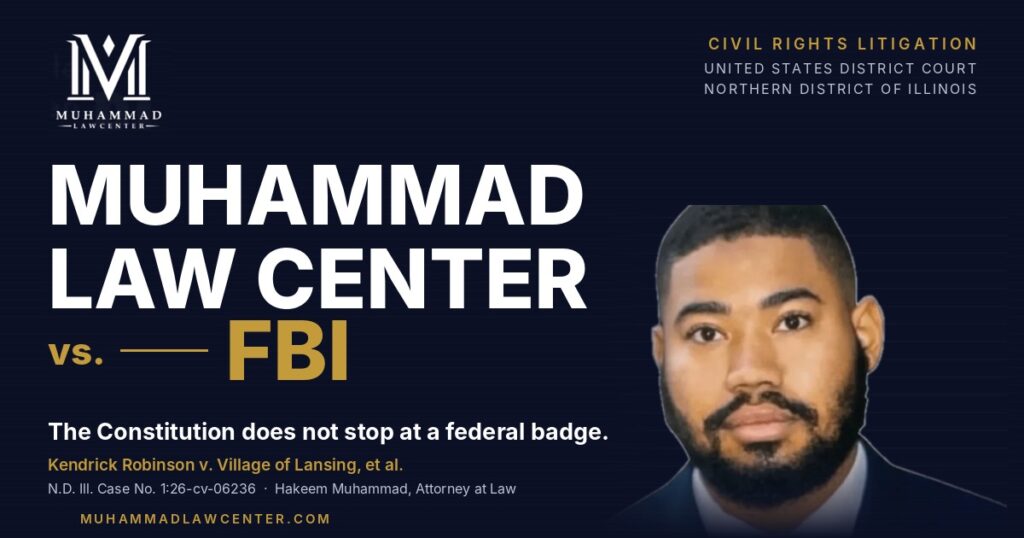
CHICAGO, October 24, 2026: Kendrick Robinson is the latest Black man to be targeted by the FBI. He was falsely arrested and jailed on a charge that did not survive a courtroom. Muhammad Law Center announces that it is representing him in a federal civil rights lawsuit against the FBI task force officer who seized him and the local police who worked alongside that officer. The case is pending in the United States District Court for the Northern District of Illinois.

Mr. Robinson was doing nothing more than going about his day in the south suburbs of Chicago when federal and local officers descended on him. They had no probable cause to arrest him. Their own paperwork said so. They seized him anyway, searched him anyway, and had him charged with a crime he did not commit. He spent more than three months in jail for a crime he did not commit. He was put through a criminal prosecution. He lost time, money, and the freedom to move through the world without looking over his shoulder.

Then the case fell apart. A judge reviewed what the officers claimed against what actually happened and threw the evidence out. The charges were dismissed. The government has never explained why it did this to him. This lawsuit will make it explain.

“We do not see this as an isolated incident, and we do not see it as an accident,” said Hakeem Muhammad, founder of Muhammad Law Center. “Mr. Robinson was not flagged, followed, stopped, and arrested because of anything he did. He was treated the way Black men have been treated by this agency for as long as it has existed: as a suspect first, a citizen second, and a person last.”

Mr. Robinson is not grateful. He is suing.

The Bureau's defense

The federal officer has argued that no one can sue him for it at all. The position of the United States government is that a federal agent who seizes a Black man without cause, searches him, and has him jailed for months on a false report is beyond the reach of the courts.

Muhammad Law Center has filed its response. The law has recognized a remedy against federal agents who search and arrest a man without probable cause since 1971. That is precisely this case. The Center will not accept that a federal badge places its wearer above the Constitution.

“Bivens is the Supreme Court's answer to a simple question: what happens when a federal agent violates the Constitution and Congress has not passed a statute saying you can sue him?” said Attorney Hakeem Muhammad. “In 1971, the Court said the Constitution itself is enough. Federal narcotics agents had broken into a man's home, searched it, and arrested him without a warrant and without probable cause, and the Court held he could sue them for damages directly under the Fourth Amendment. That is the case we are standing on. The government wants to call Mr. Robinson's arrest something new so the courts will look away. It is not new. It is Bivens with a different badge.”

Unveiling the Roots of Ancient Egypt in Contemporary Digital Gaming

As the global gaming industry continues to evolve, the allure of ancient civilizations remains a persistent source of inspiration. Among these, the mystique of Ancient Egypt has captivated audiences for centuries—manifesting not only in archaeological pursuits but also thriving within the landscape of modern digital entertainment.

Historical Context and Cultural Significance of Ancient Egypt

Ancient Egypt, a civilization renowned for its monumental architecture, intricate mythology, and rich artistic tradition, continues to fascinate scholars and enthusiasts alike. Its enduring symbols—the pyramids, the Sphinx, obelisks, and hieroglyphs—serve as cultural touchstones that transcend time. According to recent archaeological discoveries, the preservation techniques and archaeological sites from Egypt continue to yield new insights, reinforcing the civilization’s prominence in global heritage.

Modern Digital Adaptations: From Documentary to Interactive Entertainment

In recent years, the cultural motifs and iconography of Egypt have transitioned into various forms of entertainment, especially within the realm of online gaming and slot machines. This transformation is not superficial; it leverages the universal appeal of Egypt’s visual symbols to create engaging, immersive experiences for a diverse audience.

Key Aspects of Ancient Egypt in Digital Gaming
Feature Effect on Player Engagement Example
Iconography (Ankh, Scarab, Eye of Horus) Enhances thematic immersion and symbolism Prevalent in popular slot themes
Mythological Narratives Deepens storytelling layers, increasing retention Depictions of gods like Ra or Osiris
Visual Design & Symbols Creates visually stimulating experience Backgrounds resembling desert landscapes or pharaohs’ tombs

Consequently, slots and online casino games have adopted ancient Egyptian themes, often peppered with culturally significant symbols and mythos, to appeal to players’ sense of adventure and mystery. This trend underscores a broader industry insight: the blending of educational allure with entertainment maximizes engagement.

The Significance of Themed Slots: Bridging Education and Entertainment

While such digital representations focus on entertainment, they also serve as gateways to awareness about Ancient Egypt’s enduring legacy. For instance, fortune seekers may encounter game symbols reminiscent of real artifacts, offering a superficial but engaging touchpoint with history. However, industry experts emphasize the importance of authentic representation to preserve respect and accuracy.

“Integrating historical themes into gaming should balance entertainment with cultural sensitivity, fostering both engagement and respect for the civilization’s legacy.” — Dr. Amelia Carter, Cultural Historian & Gaming Ethnographer

Exploring the 5-reel ancient Egypt adventure

For those interested in exploring this fascinating intersection further, one notable resource is the Eye of Horus Bonus Slot. It exemplifies the contemporary adaptation of Egyptian mythos into an interactive gaming experience, encapsulating core symbols such as the Eye of Horus, the scarab beetle, and hieroglyphic icons, all set within an immersive 5-reel format.

Industry Insights: The Future of Egyptian-Themed Digital Gaming

As the gambling and entertainment sectors move forward, several trends are emerging:

  • Integration of Augmented Reality (AR): Bringing Egypt’s mystique into real-world environments.
  • Historical Authenticity: Collaborations with Egyptologists to develop culturally accurate content.
  • Educational Spin-offs: Games designed to inform while entertaining, fostering greater cultural appreciation.

Ultimately, the enduring appeal of ancient Egypt within digital entertainment demonstrates a potent combination of nostalgia, curiosity, and the allure of hidden treasures—an adventure that continues to captivate audiences worldwide.

Conclusion: Merging Heritage with Digital Innovation

The confluence of historical legacy and cutting-edge gaming technology exemplifies how cultural symbols can be revitalized and reinterpreted for contemporary audiences. Whether through slot machines, interactive apps, or virtual reality experiences, the 5-reel ancient Egypt adventure remains a compelling narrative that bridges the past and the future in digital entertainment. With ongoing innovations and a respectful approach to cultural heritage, this landscape promises a rich tapestry of stories and experiences for years to come.

Leave a Comment

Your email address will not be published. Required fields are marked *

Scroll to Top